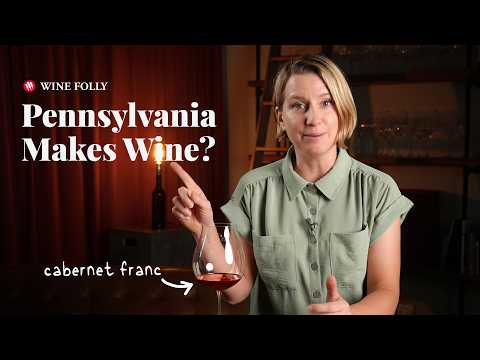
Some American wine drinkers still assume that serious wine must come from dry, Mediterranean-style climates, especially regions like California. Pennsylvania challenges that assumption with a wine story that reaches back before the United States existed and continues today through distinctive East Coast vineyards, hybrid grapes, and European varieties.
The video explores why Pennsylvania deserves a closer look, from William Penn’s 1683 vineyard to modern examples of Chambourcin, Cabernet Franc, Sauvignon Blanc, Merlot, sparkling Chardonnay, and rosé. It also highlights a key idea: high-elevation Appalachian limestone soils and Atlantic influence may give the state a moderate-climate character that invites comparison with classic European wine regions.
Wine Before America
The phrase wine older than America is not just a catchy title. Pennsylvania’s wine history is tied to William Penn, whose 1683 vineyard places the region’s wine story well before the formation of the United States. That historical detail gives Pennsylvania a rare position in American wine: it is not simply a modern experiment, but a place with deep roots in early colonial viticulture.
That history matters because it reframes how wine lovers think about the East Coast. Instead of viewing Pennsylvania as a surprising newcomer, the video presents it as a region with a long-running connection to grape growing and winemaking. The modern question is not whether Pennsylvania can make wine, but how its landscape, climate, and grape choices shape the wines being made today.
Where Pennsylvania Wine Country Fits
Pennsylvania wine country is presented through geography as much as history. The description points to high-elevation Appalachian limestone soils and an Atlantic influence, two features that help separate the state from the warmer, drier image many people associate with American wine. Rather than copying California, Pennsylvania is positioned as a moderate-climate region with its own conditions and identity.
The Atlantic influence is especially important in the way the video frames the region. Moderate climates can support wines that feel different from those grown in hotter, drier environments. The comparison to the great moderate-climate regions of Europe is not about claiming Pennsylvania is identical to those places, but about suggesting that the state has natural conditions wine enthusiasts may recognize as promising.
The Limestone Terroir Secret
One of the most compelling ideas in the video is the limestone terroir secret. Limestone soils are often discussed in wine because they can play a role in how vineyards drain, how vines grow, and how a region expresses itself through wine. In Pennsylvania, the description specifically connects Appalachian limestone soils with the state’s potential as a serious wine region.
Terroir is a useful word here because Pennsylvania’s case is not based on a single grape or a single winery. It is based on a combination of place-based factors: elevation, limestone, Atlantic influence, and a long agricultural history. Together, those ideas help explain why the video asks whether this East Coast state can rival the Old World in style, ambition, or character.
Hybrids and European Grapes
The tasting section of the video compares hybrids and European grapes, a meaningful contrast for any region working outside the most familiar West Coast wine model. Hybrid grapes can be important in regions where local conditions require resilience and adaptability, while European grapes bring names that many wine drinkers already know. Pennsylvania’s modern wine identity appears to include both.
Chambourcin is one of the highlighted grapes in the video, with a dedicated tasting section. Cabernet Franc also receives focused attention, suggesting that the grape has an important role in the Pennsylvania conversation. The description does not provide specific tasting flavors, but it makes clear that both grapes are part of the state’s current wine story and part of the broader question of who these wines are for.
Wines Featured in the Pennsylvania Lineup
The wines associated with the video show a broad view of what Pennsylvania producers are working with. The list includes South Shore Sparkling Chardonnay NV and South Shore The Perfect Rose 2024, along with Waltz Vineyard Cabernet Franc 2021 and Waltz Vineyard Merlot Cherry Tree 2021. These examples point to both sparkling and still wines, as well as red and rosé styles.
Other featured bottles include Armstrong Valley Sauvignon Blanc 2024, Armstrong Valley Winery Estate Reserve Cab Franc 2022, Nissley Chambourcin 2024, and Fero Saperavi Rose 2024. Karamoor Estate appears with Sauvignon Blanc 2024 and Merlot 2023, while Penns Woods is represented by Cab Franc Reserve 2023 and Sauvignon Blanc 2025. Taken together, the lineup emphasizes variety rather than a one-grape identity.
Who Are Pennsylvania Wines For
The video directly raises the question of who these wines are for. Based on the description, Pennsylvania wines should interest drinkers who are curious about American wine beyond the most famous regions, as well as those who enjoy exploring how climate, soil, and grape selection influence style. They may also appeal to people who like comparing familiar European varieties with hybrid grapes that are part of regional wine culture.
For beginners, Pennsylvania is a useful case study because it challenges simple assumptions. It shows that wine country is not defined only by sunshine, heat, or global fame. For more experienced tasters, the state offers a chance to think about moderate-climate wine in an American setting shaped by Appalachian terrain, limestone soils, and Atlantic conditions.
The Future of East Coast Wine
The final chapter of the video looks toward the future of East Coast wine. Pennsylvania’s combination of early wine history and modern experimentation makes it a strong example of how American wine continues to broaden. The state’s story includes William Penn’s 1683 vineyard, but it does not stop there; it continues through contemporary producers working with grapes such as Chambourcin, Cabernet Franc, Sauvignon Blanc, Merlot, Chardonnay, and Saperavi rosé.
Whether Pennsylvania can truly rival the Old World is the central question the video invites viewers to consider. What is clear from the title and description is that the state has more to offer than many wine enthusiasts may expect. Its history is older than the country, its terroir is more complex than the stereotype, and its current wine scene is worth watching for anyone interested in the evolving map of American wine.
#pennsylvaniawine #eastcoastwine #winetasting #cabernetfranc #chambourcin